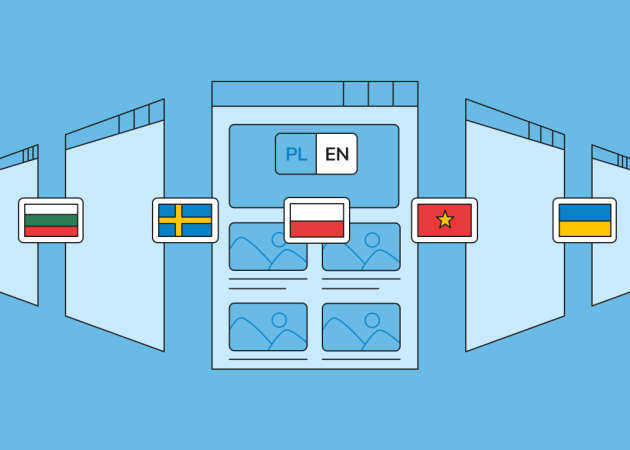
Multisite vs. Multilingual: Choosing the Right Architecture for Global WordPress Websites

Contents
Contents
Your company just signed off on expansion into five new markets, and the website brief lands on someone’s desk with a single line: “translate the site.” It sounds simple. Translate the content into the right languages, and the site is ready for its new markets. But translation is only one layer of a larger decision, while the layer underneath determines whether the site holds up as you grow.
The structure beneath the content, meaning how sites, languages, and teams are organized, shapes how the website scales, who owns what, how search engines interpret each market, and how much effort maintenance takes over time. Sound WordPress website design starts with that structure, well before the first page is translated.
For organizations building on WordPress, that structural decision usually comes down to two approaches: a WordPress multisite network, or a single multilingual website that manages several languages within one installation. The choice between the two starts with how your organization actually works: who owns content, how independently markets operate, and how much the structure needs to change as the business grows.
Global Website Architecture Starts With Business Strategy
Before comparing WordPress features, it helps to describe how the business itself is arranged. The scale of the opportunity is easy to underestimate: English fills close to half of all web content, while fewer than one in five people worldwide speak the language. That gap is where multi-market architecture earns its keep. A retailer with one central marketing team publishing consistent messaging across a dozen countries operates very differently from a holding company whose regional offices run their own campaigns, pricing, and legal disclosures. The website should reflect that operating model.
Three questions tend to drive the architecture. First, how is content ownership distributed: does one team publish for every market, or do regional teams control their own pages? Second, what does market expansion look like over the next few years: adding languages to existing markets, or standing up genuinely separate country operations? Third, how much content governance does the organization need, meaning central control over brand, structure, and compliance versus local autonomy? The answers point toward one architecture or another.
WordPress can support both architectural directions, which is why the decision should start with the business rather than with a preferred feature or setup. The question is whether the website needs to mirror one centralized operation or accommodate distinct markets with greater independence. Teams that need additional WordPress capacity can hire WordPress developers or work with a partner experienced in designing both models.
What Is a WordPress Multisite Architecture?
A multisite WordPress setup runs several distinct websites from a single WordPress installation, sharing the same core files and database. It keeps each site separate in terms of content, users, and settings. Instead of one site serving many languages, the network hosts many sites, each of which can have its own domain or subdirectory, editorial team, and publishing rules.
The value of a multisite network is organizational more than technical. It suits businesses whose markets or brands operate with independence: a company where the German, Japanese, and Brazilian teams each manage their own pages, run their own campaigns, and answer to different regional requirements.
Central IT still maintains the platform, applies updates, and sets baseline standards, while day-to-day publishing sits with the people closest to each market. That balance of centralized publishing infrastructure and local editorial control is what multisite does well. It fits federated organizations, multi-brand portfolios, and any structure where regional websites need to diverge in more than just language.
What Is a Multilingual WordPress Architecture?
A multilingual WordPress website follows a different model. It runs a single site that presents its content in several languages, usually through a translation plugin that connects each piece of content to its counterparts in other languages. There is one site, one content structure, and one set of editorial rules, with language as a layer on top.
This model fits organizations that want consistency. When branding, messaging, and business operations are shared across markets, multilingual SEO and a single content structure keep everything aligned. A change to a product description or a policy page can be made once and then translated, rather than coordinated across independent sites.
For many companies, multilingual website development is sufficient for international growth precisely because their markets differ by language and currency but not by governance. A sound localization strategy and a clear translation workflow matter more here than site separation, and both are easier to enforce when everything lives in one place.
More insights on building multilingual sites well:
Multisite vs. Multilingual: Choosing the Right Approach
The clearest way to compare the two is by looking at how each behaves across the dimensions that shape long-term cost and effort:
- Governance: Multisite supports greater autonomy at the site level, while multilingual tends to favor centralized control.
- Scalability: Multisite can accommodate new regional or brand sites with distinct requirements, while multilingual scales more naturally when expansion means adding languages to an otherwise shared experience.
- Content management: Multisite lets each market build pages that have no equivalent elsewhere, while multilingual works best when every market carries broadly the same content in different languages.
- Maintenance: A single multilingual site typically involves fewer configurations to maintain because there is one site environment to manage. A multisite network centralizes platform maintenance, so an update can reach every site at once, which improves efficiency but makes careful testing across the network more important.
- Localization: Multilingual handles language variation within one structure, while multisite can support deeper localized content where markets differ in more than language.
- SEO: Both models can perform well, but the architecture changes how teams manage URL structures, market targeting, and other international SEO requirements.
- Operational complexity: This tends to increase with multisite as the number of independent teams, configurations, and publishing workflows grows. A multilingual setup keeps more of that activity within one shared structure, though translation and localization workflows introduce complexity of their own.
These differences do not add up to a universal winner. The right architecture is the one whose trade-offs match how the business operates.
When Multisite Makes Sense
Multisite can justify the additional complexity when markets are genuinely independent. Consider a business with regional teams that publish on their own schedules, a portfolio of separate brands under one corporate umbrella, or country targeting that carries distinct legal, regulatory, or operational requirements per market.
In these cases, forcing every market into one shared content structure creates friction. Separate sites let each team move at its own pace, meet its own compliance obligations, and shape pages around local needs. Shared infrastructure and standards stay in place underneath.
When Multilingual Makes Sense
Multilingual is the more practical option when the business runs as one operation across borders. If branding is consistent, the product or service is broadly the same everywhere, and a central team owns the content, then a single multilingual website avoids the overhead of maintaining several sites. It keeps messaging aligned, simplifies updates, and gives a smaller team a manageable structure.
For companies expanding by language rather than by autonomous business units, this is the sensible starting point. It answers the practical question of how to make a website multilingual without committing to a network before one is needed.
When a Hybrid Architecture Is the Best Fit
Some organizations do not fit neatly into either model, and for them a hybrid arrangement works best. A common pattern is a multisite WordPress network in which individual sites are themselves multilingual. A company might run separate sites for North America, Europe, and Asia to reflect independent regional operations, while each of those regional sites serves several languages to cover the markets within it.
This approach balances central global content management with regional flexibility. Corporate keeps oversight of the network and shared standards, regional teams own their sites, and language is handled within each region. The trade-off is that a hybrid carries the maintenance and governance demands of both models. It makes sense when the business operates at both levels: regions function independently, but each region also serves multiple languages. Deciding whether that complexity is justified is easier with an honest WordPress audit of current needs and future plans.
SEO Considerations for Global Websites
Architecture and search visibility are closely linked, and the choice between models has direct consequences for international SEO. A key element is hreflang implementation, which helps search engines understand the language or regional targeting of alternate page versions and serve the appropriate one in search results. A multilingual site manages these relationships within one content structure, while a multisite network may need to coordinate them across separate regional sites.
The other architectural decision is URL structure. Multilingual sites typically use subdirectories or subdomains for each language, while a multisite network can give markets separate domains, including country-code domains where explicit country targeting is useful. Similar or overlapping pages can exist under either architecture, so teams need consistent hreflang, canonical, and indexing signals to help search engines understand the intended relationship between them. Architecture can establish the right technical signals, but strong multilingual SEO still depends on content that is localized for each market.
Technical targeting is only part of the picture. Global sites also need to perform reliably for users across regions, which makes WordPress performance optimization a related architectural consideration.
Planning Your Global Website Architecture From Day One
The most sustainable global sites are planned around where the business is heading. A useful framework starts with the three questions raised earlier and adds a fourth about timing. How is content owned now, and will that change? Do the markets need to diverge, or mainly to speak different languages? How much central governance is required? And how soon is the next phase of expansion likely to arrive?
A business that expects to remain centralized may have little reason to introduce multisite complexity from the outset. One that already runs autonomous regional teams may benefit from planning for that separation early, before content, workflows, and integrations make it harder to introduce.
The goal is a deliberate choice, made before content and links accumulate around an architecture that later proves limiting. This is where experienced architectural planning matters. Beetweb approaches these decisions by matching the architecture to how an organization operates, not defaulting to the most elaborate option, and applies custom WordPress development where standard configurations do not fit.
Read on why architecture and custom work still matter:
Choosing an Architecture That Grows With You
The decision between multisite and multilingual is a business architecture decision before it is a technical one. Multisite suits organizations whose markets operate independently and need room to diverge. Multilingual suits those that run as one operation and want consistency across languages. Some organizations need a hybrid of the two.
What matters is evaluating how the website structure will support future growth, not only today’s requirements. The cost of the wrong structure can show up later in maintenance overhead, governance friction, and SEO complexity. The right architecture is the one that supports how an organization operates and grows. If you are mapping out an international expansion and need help choosing an architecture, the Beetweb team can help you work through the options.
FAQs
When should a business choose WordPress Multisite instead of a multilingual website?
A business should choose WordPress multisite instead of a multilingual website when its markets or brands operate independently, with separate regional teams, distinct publishing workflows, or country-specific legal and operational requirements. WordPress Multisite allows each site to maintain its own content and editorial workflows, while sharing core infrastructure, whereas a multilingual website is better suited to organizations that manage one consistent operation across languages.
Can a WordPress website be both multisite and multilingual?
Yes, a WordPress website can be both multisite and multilingual. In a hybrid setup, a WordPress Multisite network runs several separate sites, and each of those sites serves its content in multiple languages. This combination suits organizations that operate through independent regional sites while also needing to support several languages within each region.
Does WordPress Multisite improve international SEO?
WordPress Multisite does not automatically improve international SEO, but it can support it when configured correctly. A multisite network can support separate domains and independent structures for individual markets, but it also requires deliberate coordination of hreflang, URL structures, and other technical signals across sites.
What is the difference between a multilingual website and a multisite network?
The difference between a multilingual website and a multisite network is one of structure. A multilingual website is a single WordPress site that presents the same content in several languages under one shared structure and governance. A multisite network consists of several separate WordPress sites run from one installation, each with its own content, settings, and editorial workflows.
How do hreflang tags support multilingual and multisite websites?
Hreflang tags support multilingual and multisite websites by helping search engines understand the language or regional targeting of alternate page versions and serve the appropriate version in search results. On a multilingual website, hreflang tags connect language versions within one installation. On a multisite network, hreflang tags must be coordinated across separate sites so search engines correctly associate the regional variants.
Subscribe to blog updates
Get the best new articles in your inbox. Get the lastest content first.

Recent articles from our magazine



Contact Us
Find out how we can help extend your tech team for sustainable growth.